★ Click here to enter the Trout and Salmon crossword for the chance to win a Loop Z1 double-handed rod★

Brutus amongst the rocks
Rob Hardy visits the River Ure with a box of streamers

While they might have fly-fishing purists snapping their 7X in disgust, few can deny the effectiveness of streamer flies – particularly when it comes to tempting a river’s largest fish. It was with just such a mission in mind that I set out on Yorkshire’s River Ure, accompanied by Sam Harrison, operations manager for the Northern Fishing School.
Sam, more accustomed to working behind the scenes than in front of the camera, had told us that he and several of his rods had recently been catching quality wild brown trout on streamer tactics from the Swinton Estate waters, which the Northern Fishing School (NFS) manages. With autumn fast approaching, it felt like the perfect time to join him on the river and see if he could conjure up one of these aggressive late-season bruisers.
As most anglers know, venturing on to a river with a plan, rather than adapting to the conditions in front of you, is always risky and sets you up for a fall. Undeterred, we met Sam at the school’s base in the grounds of Swinton Park Hotel before making the short drive to his chosen beat. He had also called in reinforcements in the form of his friend Hannah Russell and syndicate members Tom Webster and Rich Gallagher, hoping that extra rod pressure might stir up the usually lightly fished stretches.

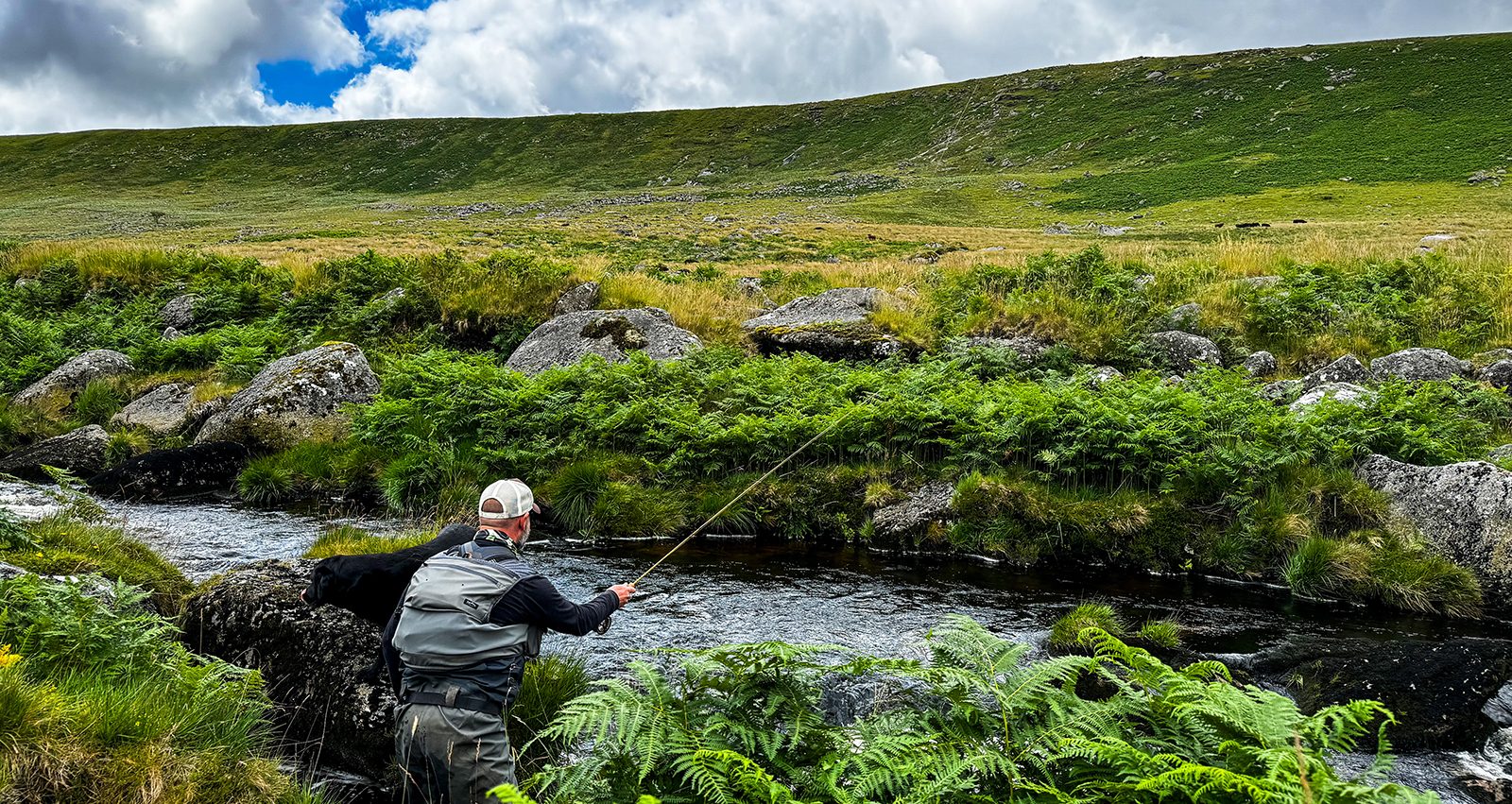
We began on the Upper High Mains beat, a lovely mixture of fast riffles, smooth glides and deep pools. Well kept, yet full of fish-holding structure – large rocks, fallen trees, undercut banks and overhanging foliage – it was easy to see why this stretch had produced trout to 5lb the previous season, with Sam himself landing a 3lb specimen only days before our visit.
He and Hannah started off from the middle of the beat, working their way downstream, while Tom and Rich began at the top, planning to fish down to meet me.
As well as a 9ft 3in seven-weight rod with a floating single-handed spey line and conventional streamers dressed with beads, cones or skullheads, Sam carried a second outfit: an Adams three-weight Euro-nymph rod armed with a small jig streamer from Fulling Mill, which he would bounce through the deeper runs. The method was akin to fishing a beaded nymph, though on a stout 4X tippet.
“I’m off to Slovenia in a week,” Sam explained, “and I think it’s a technique we’ll be using a lot to target big marble trout. It’s a deadly method, one that really picks out the better fish used to preying on small baitfish and crayfish.”
His tip for anyone wanting to try the method was to cast slightly upstream and fish the fly with a conventional high-stick dead drift until facing downstream. “Then drop the rod tip a little and allow the fly to swing across the current like a wet fly – but be ready. The takes, as the fly lifts off the bottom, can be absolutely arm-wrenching.”
The warm, overcast September morning brought our anglers several hefty pulls, though only a smattering of small trout and grayling came to hand. It was close to lunchtime before my phone rang Sam had a better fish in the net. Not the monster we were chasing, but at around 1½lb it was long, lean, and every inch a hunter. It had taken a white rabbit-fur skullhead in the Embankment Pool, a favourite of Sam’s thanks to its steady depth and abundant holding features.
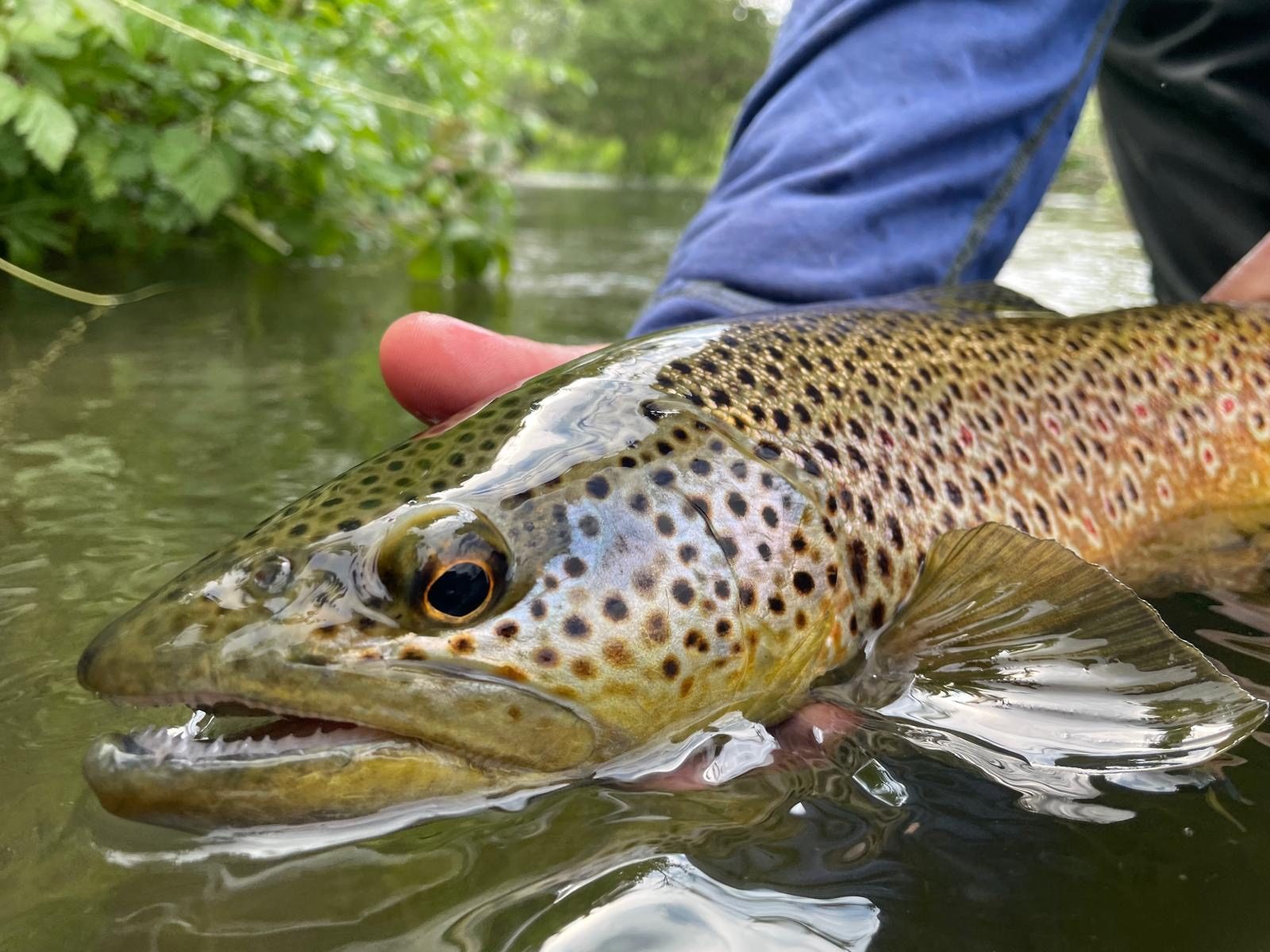
No sooner had I finished photographing his fish than Tom was into the action up at Boundary, near the top of the beat. His trout, with deep-spotted shoulders and golden flanks, weighed a good 2lb and was much more in line with what we had hoped for. Things were looking up.
On my way back down the beat I stopped to chat with Hannah, who had joined us to gain some valuable rod hours after only taking up fly-fishing three years earlier.
She explained, “I grew up with farming and country sports, and I’ve shot since the age of 14. I always fancied trying fly-fishing but never did anything about it until I joined one of the NFS Cancer and Pisces Trust days at Swinton. I was at a loose end after my treatment and found fly-fishing really mindful. It allows me to switch off from a busy work schedule.”

Hannah is also a familiar face on the grouse moors and local shoots, where she picks up with her spaniel Elvis and flatcoat retriever, Winston, with Pip the teckel in support.
The 1.3-mile right-bank Upper Mains beat accommodates a maximum of three rods per day, syndicate or day-ticket anglers. This ensures plenty of space across its 12 named pools, not to mention the countless runs, pots and holding spots between them. The NFS deliberately keeps rod pressure light, and with access only by 4×4 or a 200-yard walk from the nearest parking spot, the beat suits anglers seeking solitude away from the bustle of everyday life. The banks and wading can be testing, and full coverage requires a decent level of fitness, but the rewards are more than worth the effort. With excellent water for nymphs and Spiders, good hatches of olives and sedges for the dry-fly enthusiast, and plenty of streamer potential, it offers something for everyone.
As luck would have it, Sam and I had just returned to the tricky yet productive neck of Embankment Pool when Tom struck again and I only had to hot-foot it a few yards to see him land his second of the day, another beautiful golden trout pushing 2lb. A small beaded nymph on his French leader set-up had proved irresistible.
After returning it with some lively banter – Tom offering Sam his guiding services – I asked Sam how he liked to fish his streamers.
“It’s dependent on the day and the water I’m covering,” he said. “On some days they will want it retrieved with short, fast pulls and absolutely hammer the fly, while on others only a slow figure-of-eight retrieve will bring results. You are barely moving the fly, and the takes can be so subtle you think you have just touched bottom – until it all tightens up. I just keep mixing things up until I can find out what they prefer.”
After a quick stop for a cold drink from the superbly kitted-out NFS vehicle, Sam suggested moving to Lower High Mains, around two miles downstream.
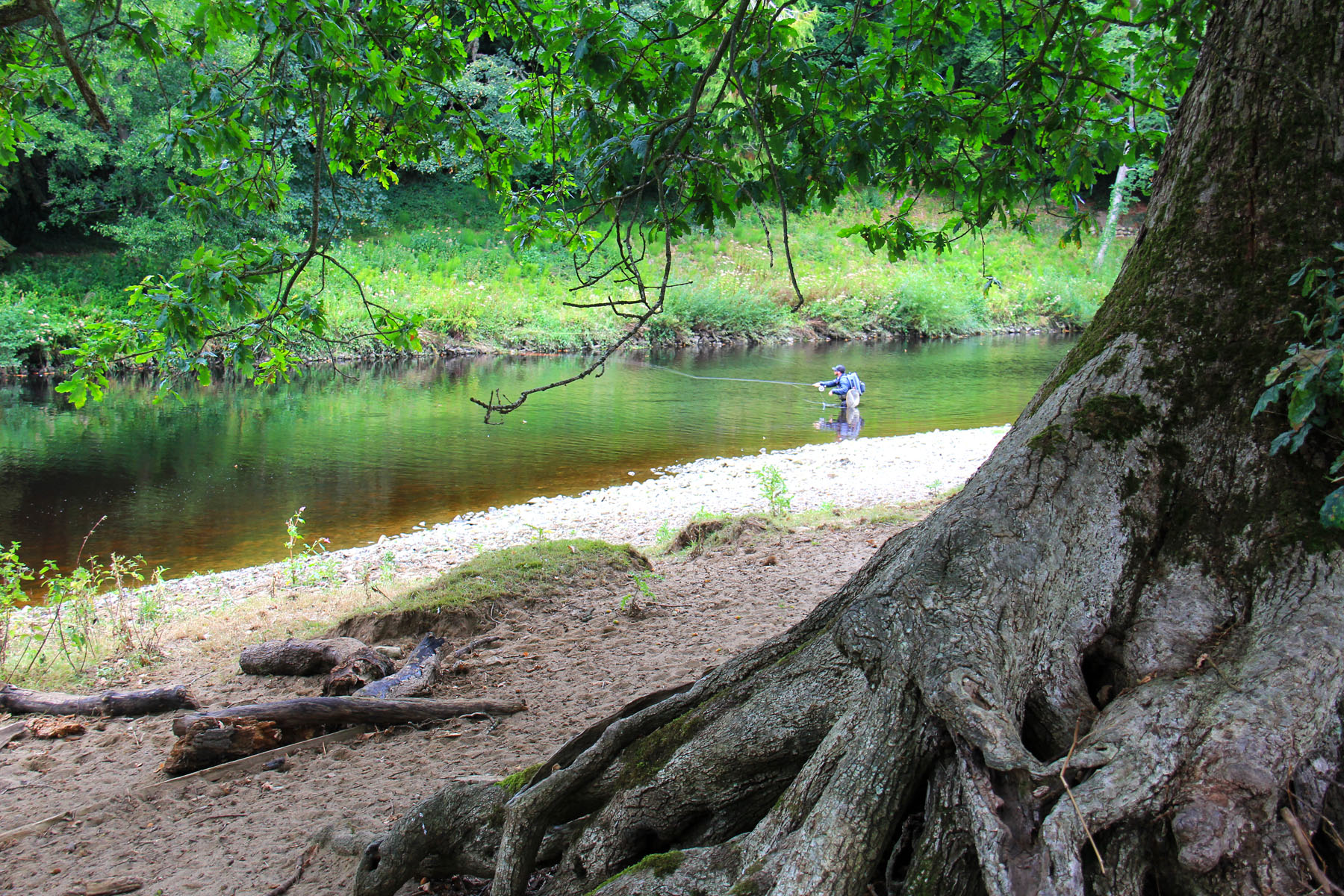
This 1.3-mile beat offers a similar variety of water, but with flatter surroundings of parkland dotted with ancient oaks, their twisted roots bared by winter floods. Like the upper, it is limited to three rods per day, with day tickets available through the NFS. The major landmark here is the magnificent Clifton Castle, built in 1802, which towers above the beat and provides a dramatic backdrop while fishing the middle pools.
Sam immediately targeted a known big-fish lie beneath a massive root ball just off the main current. Pinpoint accuracy was needed to drop the fly close enough, and inevitably the odd cast strayed a few inches, costing him a jig streamer or two. It was a necessary sacrifice to the fishing gods.
With everyone giving their all, Tom was first to score again in the run below the castle. While not quite as big as his previous fish, it was in excellent condition, butter fat and heavily spotted, a wild trout that anyone would be proud to land.
We worked our way up the beat, leaving no likely spot untouched. Sam had high hopes for Castle Pool, a long sweeping corner littered with rocks and far bank snags, it was home to several large trout, including one Sam had affectionately named Brutus.
These two had history, having locked swords on a number of occasions – Brutus still holding the upper hand. Sam had landed him twice in recent years, so he knew the fish averaged around 4lb. He had saved the pool until last, knowing from painful experience he would get just one chance. As long as the presentation was good, Brutus was not difficult to tempt – his size gave him first claim to any food. But nestled within his haven of rocks and roots extraction of this powerful and wily trout was the nub of the problem.
Armed with his seven-weight and stout 10lb leader, Sam fished his way from the top of the bend, inching his way, cast by cast towards the lie. Finally, he was above the far-bank rocks where Sam hoped to hook the fish and, with side-strain, immediately get his head upstream, away from potential disaster. His first cast was on the money and as the streamer began its swing, the line tightened. Sam immediately piled on the pressure and for a second it looked like the plan was working, but on feeling the hookpoint the trout had beaten him to the draw, taking what little slack there was and bolting downstream tight to the far bank. Running with the rod raised high above his head, all Sam could do now was to try to avert calamity by holding as much line as possible off the water and follow it downstream, hoping he could get below the fish before it buried itself among the snags. Alas, the first headlong rush had proved enough to drag the leader through the rocks and with no little cunning, it had then wrapped it around one of the larger ones and thrown the hook, leaving Sam frustrated but philosophical about the outcome.
“You win some, you lose some,” he said. “I’ll get him next time.”
It was a fitting final act, one which, like the day itself, may not have gone exactly to plan but had delivered us highs and lows, excitement and challenges and, most importantly of all, stunning trout in wonderful surroundings.
Related Articles
Tips and advice
Trout
Luck, skill and the anglers who always seem to catch
We all know the angler who catches on the day nothing is happening, the one everyone calls lucky. Watch a little more closely and a different picture emerges, made up of small habits and quiet decisio...
By Pete Tyjas
Tips and advice
Trout
The parachute cast: a simple skill that solves big problems
On UK rivers, drag is the dry-fly angler's constant enemy. The parachute cast is the quiet, unglamorous answer, building slack into the line so the fly drifts naturally for those few extra seconds tha...